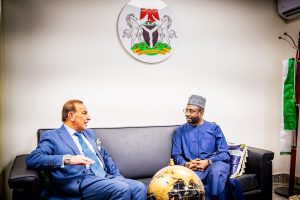
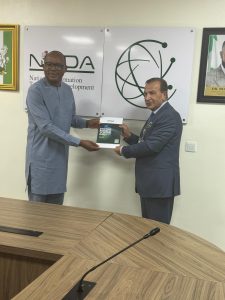
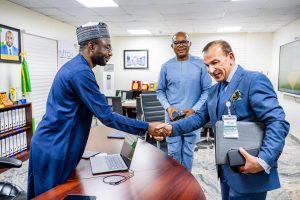
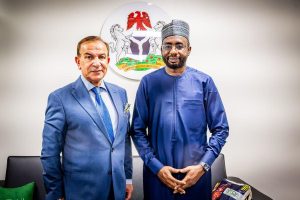
The Vice-Chancellor and Chief Executive Officer of Wigwe University, Professor Marwan Al-Akaidi, on February 11, 2026, paid a strategic courtesy visit to the Director-General/CEO, National Information Technology Development Agency (NITDA), Kashifu Inuwa Abdullahi, in Abuja, signaling the beginning of what both institutions described as a high-level collaboration to advance Nigeria’s digital economy.
The engagement focused on Artificial Intelligence (AI), applied research, digital skills development, agricultural innovation, accessibility of quality education to Nigerians and curriculum alignment with national and industry priorities.
During the discussions, Mr. Abdullahi outlined its Strategic Roadmap and Action Plan (SRAP 2.0), which prioritizes digital literacy and talent cultivation, development of a robust innovation ecosystem, support for research and emerging technologies, entrepreneurship, and inclusive strategic partnerships to accelerate national digital transformation. Both parties noted a strong convergence between NITDA’s mandate and Wigwe University’s innovation-driven academic model.
Central to the discussions were discussion on scholarships for academically endowed Nigerians to study at Wigwe University, strategic propositions in AI for health and agriculture. Professor Al-Akaidi reaffirmed the readiness of Wigwe University to lead from the fore in matters of Artificial Intelligence in Health initiatives and proposed structured collaboration on AI-driven malaria detection, predictive analytics, and data-enabled public health optimization, emphasizing that research must be practical, outcome-based, and measurable in national impact.
In field of agriculture, Professor Al-Akaidi highlighted Nigeria’s dairy productivity gap despite its large cattle population and proposed AI-enabled livestock monitoring, yield optimization, and precision agriculture systems. The dialogue referenced NITDA’s National Adopted Village for Smart Agriculture programme as a model for linking research, technology adoption, and commercialization to food security and economic development objectives.
On curriculum and industry integration, the Vice-Chancellor stressed the need for annual curriculum updates to remain responsive to market realities. He noted that while approximately 70 percent of academic content is guided by regulatory standards, the remaining 30 percent should be co-developed with industry and agencies such as NITDA.
Professor Al-Akaidi and the Director-General further explored executive-level collaboration frameworks and long-term institutional partnerships, with follow-up operational discussions involving the Director Stakeholders Management and Partnerships, Dr. Aristotle Onumo and Special Assistant on Strategy and Innovation to the DG of NITDA, Iklima Musa. The visit concluded with agreements to submit clearly defined collaboration proposals, designate focal persons from both institutions, identify pilot initiatives in AI for health and agriculture, and develop a structured framework for applied research and curriculum collaboration—marking a transition from courtesy engagement to strategic alignment with measurable national impact.